ggBleed
A 1-D multi-physics simulation of a turbofan engine's bleed air system, from bleed ports through pressure regulation to the precooler.

Objective
Model bleed air pressure regulation and precooler heat transfer across a full flight mission, using only public sources, and validate the results against published cases.
Project Overview
Aircraft ECS design is the work I know best, and I wanted something I could actually show. So this is built only from public data: published papers, theses and government reports, with every value cited. The models run in OpenModelica, which is open source, so nothing here depends on a paid tool.
ggBleed models how an airliner’s engines supply bleed air to the aircraft: hot, high-pressure air taken from the engine compressor, regulated, and cooled before it goes to air conditioning, anti-ice and pressurization. It feeds directly into ggPack, the air conditioning pack model.
Roadmap & Development Phases
The model progresses through the following milestones:
Core Models
Python and OpenModelica bleed models with a pytest suite.
Public-Sources Audit
Every parameter traced to a public source, derived, or labelled as an assumption, enforced by a checker in the test suite.
Validation
Compare against published measured and simulated cases from the research library.
Write-Up
Results, validation plots, and lessons learned.
What It Models
- Compressible gas dynamics: ideal-gas properties, isentropic and choked/unchoked orifice flow, and the standard atmosphere.
- Precooler: ε-NTU crossflow heat exchanger with a lumped core thermal mass. The core time constant comes from an identified precooler model,1 and the conductance is solved from two published flight-test cases.2
- Valves and control: high-stage valve, a pressure-regulating shutoff valve (PRSOV) holding a gauge setpoint, and a fan air valve driven by an outlet thermostat. The setpoint, control band, temperature limit and overheat trip come from an incident investigation report,3 and the sensor and valve lags from a laboratory bleed rig.4
- Flight mission: ground, takeoff, climb, cruise with a wing anti-ice step, idle descent and approach, rebuilt from published engine port states,56 a published cruise point7 and the standard atmosphere.
Technical Approach
The same system is built twice: a causal Python model and an acausal OpenModelica model, so the two paradigms can be compared side by side. The OpenModelica cruise experiment closes the plant with boundary sources and sinks and runs at the same published cruise point as the Python mission.7
Validation
So far the model is checked against published limits, not fitted to measured data:
- Through climb and cruise, the sensed precooler outlet stays inside the published control band,3 the intermediate stage supplies cruise, the high stage takes over in descent, and nothing trips.
- The PRSOV regulates to the published setpoint, and the temperature limit and trip act at the published values.3
- The precooler’s conductance is solved so the two flight-test cases land in that band.2
The OpenModelica cruise experiment settles on the same setpoint and band. Measured-data validation cases are catalogued in the research library and are the next phase.
Results
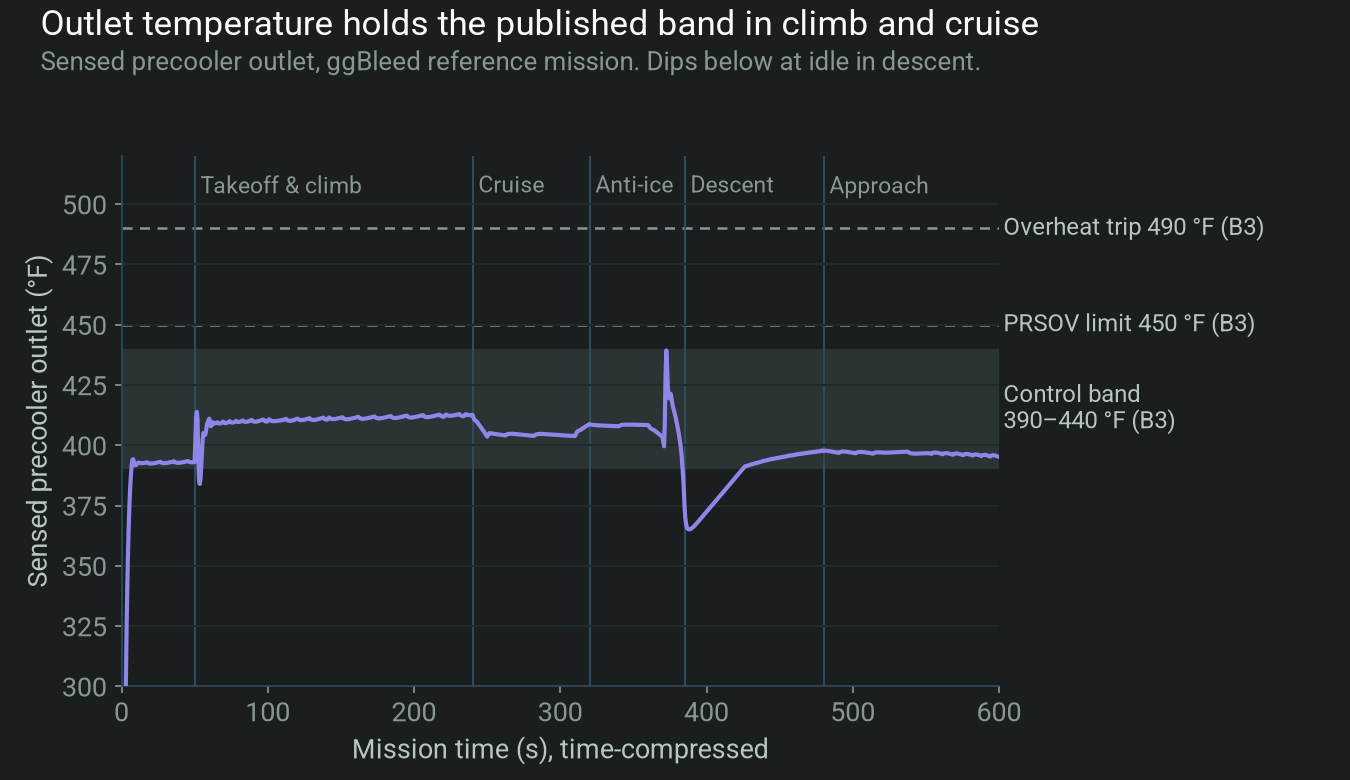
The sensed outlet temperature holds the published 390–440 °F band through climb and cruise3 and dips below it at idle power in descent. It never reaches the temperature limit or the overheat trip.
Research
The parameters and validation cases come from a curated library of 28 public papers, reports and theses on aircraft bleed and air conditioning systems, each read and filed with a short summary and notes on where its data sits. Progress notes and research findings are posted below as the work goes on.
Sources & Disclaimer
This is an independent educational project. It is a 737-800-class reference architecture built only from public sources: peer-reviewed papers, a doctoral dissertation, an FAA technical report and a government incident report. No manufacturer, maintenance, training or other proprietary documents were used, and it is not a replica of any manufacturer’s hardware. It is not affiliated with or endorsed by Boeing, Airbus, or any equipment supplier.
Every model value in the code is tagged to one of the references below, to a derivation written out from them, to textbook physics, or to a labelled generic modelling assumption. A provenance checker runs with the test suite and fails the build on any untagged value.
References
-
Shi, Dong, Liu, Luo (2024). “Study on Construction and Identification of Dynamic Model of Precooler in Aviation Bleed Air System”. Journal of Northwestern Polytechnical University 42(6): 1089. Table 2, Eq. 19. doi:10.1051/jnwpu/20244261089 ↑
-
Peng (2022). “Research and Verification on the Solution of Bleed Air Temperature Deviation of Civil Aircraft Pneumatic System”. Journal of Physics: Conference Series 2410: 012009. Table 1. doi:10.1088/1742-6596/2410/1/012009 ↑ ↑2
-
Air Accident Investigation Bureau Malaysia (2025). Aircraft Serious Incident Final Report SI 04/24, Boeing 737-800 9M-LCM. Ministry of Transport Malaysia. §1.6.2, §2.1.1, Figs. 9–10. Report (PDF) ↑ ↑2 ↑3 ↑4
-
Shang (2011). Fault Detection and Isolation in an Aircraft Engine Bleed Air System. PhD dissertation, Ryerson University. Ch. 2 and Ch. 5. doi:10.32920/ryerson.14646084 ↑
-
Jones (2022). Aircraft Air Quality and Bleed Air Contamination Detection. FAA report DOT/FAA/TC-21/45. Table 56. ROSA P ↑
-
Dai, Cui (2025). “Thermal Dynamic Simulation Study of the Aircraft ECS Laboratory Air Source”. Journal of Physics: Conference Series 2992: 012049. §2, Tables 1–2. doi:10.1088/1742-6596/2992/1/012049 ↑
-
Jennions, Ali, Esperon-Miguez, Camacho Escobar (2020). “Simulation of an Aircraft Environmental Control System”. Applied Thermal Engineering 172: 114925. Table 2. doi:10.1016/j.applthermaleng.2020.114925 ↑ ↑2
Project Log
No log entries found for this project.